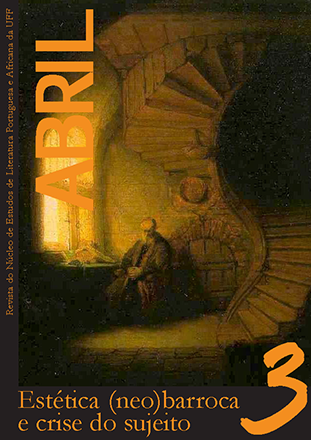
Vol. 2 No. 3 (2009): (NEO)BARROQUE AESTHETICS AND THE CRISIS OF THE SUBJECT

					View Vol. 2 No. 3 (2009): (NEO)BARROQUE AESTHETICS AND THE CRISIS OF THE SUBJECT
2nd. sem.: Jul.-Dec. 2009.
Issue date: Nov. 30, 2009.
Published: 2010-11-30

Introduction

  • Introduction

    Dalva Calvão, Maria Lúcia Wiltshire de Oliveira
    6
    DOI: https://doi.org/10.22409/abriluff.v2i3.29796

Articles

  • “A fuga para o Egipto” (the escape to Egypt): colour pulsation and meaning in a (neo)baroque concert

    Maria Theresa Abelha Alves
    8-20
    DOI: https://doi.org/10.22409/abriluff.v2i3.29797
  • “The shortest distance between two dots...” On the concept of fold as a world vision and writing technique in Maria Gabbriela Llansol

    Aderaldo Ferreira de Sousa Filho
    21-30
    DOI: https://doi.org/10.22409/abriluff.v2i3.29798
  • Antônio Vieira and the awareness of the play: the rectoric and ontological worlds in the baroque period genesis

    Artur Almeida de Ataíde
    31-46
    DOI: https://doi.org/10.22409/abriluff.v2i3.29799
  • “Brazilian fruits”: an allegory of the new world

    Berty R. R. Biron
    47-57
    DOI: https://doi.org/10.22409/abriluff.v2i3.29800
  • An attempt to push the shadows away: “The coast of whispers”, by Lídia Jorge

    Isa Lopes Coelho
    58-65
    DOI: https://doi.org/10.22409/abriluff.v2i3.29801
  • The (neo)baroque in the glow of the “Contos do mal errante” writing

    Jane Rodrigues dos Santos
    66-80
    DOI: https://doi.org/10.22409/abriluff.v2i3.29802
  • The paths and detours in “The court of the north”, novel by Agustina Bessa-Luís: a neobarroque reading

    Marcelo Brandão Mattos
    81-88
    DOI: https://doi.org/10.22409/abriluff.v2i3.29803
  • The new narrative disorder–subject, time and discourse centered in the women's novels in Portugal

    João Barrento
    89-98
    DOI: https://doi.org/10.22409/abriluff.v2i3.29804
  • “All the names”, by José Saramago: a text within folds

    Maria Cecília Rogers Paranhos
    99-108
    DOI: https://doi.org/10.22409/abriluff.v2i3.29805
  • The saturnine look of António Lobo Antunes in “What can I do when everything is on fire?”

    Maria Cristina Chaves de Carvalho
    109-119
    DOI: https://doi.org/10.22409/abriluff.v2i3.29806
  • From the barroque musicality in “The inquisitors' manual”

    Mariana Neto Silva Andrade
    120-131
    DOI: https://doi.org/10.22409/abriluff.v2i3.29807
  • Days in frumpiness: the fictionalization of the diary in “The shimmering umbrellas”, by Teolinda Gersão

    Roberta Guimarães Franco
    132-142
    DOI: https://doi.org/10.22409/abriluff.v2i3.29808
  • Baroque impressions in an Agustina Bessa-Luís narrative

    Viviane Vasconcelos
    143-153
    DOI: https://doi.org/10.22409/abriluff.v2i3.29809
  • A concept of poetics

    Nuno Júdice
    154-159
    DOI: https://doi.org/10.22409/abriluff.v2i3.29810

Interviews

  • “... To jump from what is experienced to what is written, this is poetry...”

    Carla Miguelote
    161-164
    DOI: https://doi.org/10.22409/abriluff.v2i3.29811

Reviews

  • A history of departures: women, emigrants and foreigners

    Mônica Figueiredo
    165-167
    DOI: https://doi.org/10.22409/abriluff.v2i3.29812
  • A train to the starts

    Renata Flávia da Silva
    168-171
    DOI: https://doi.org/10.22409/abriluff.v2i3.29813
  • About this issue

    1-5
    DOI: https://doi.org/10.22409/abriluff.v2i3.29814